
We Need a Certain Level of “Give a Shit”
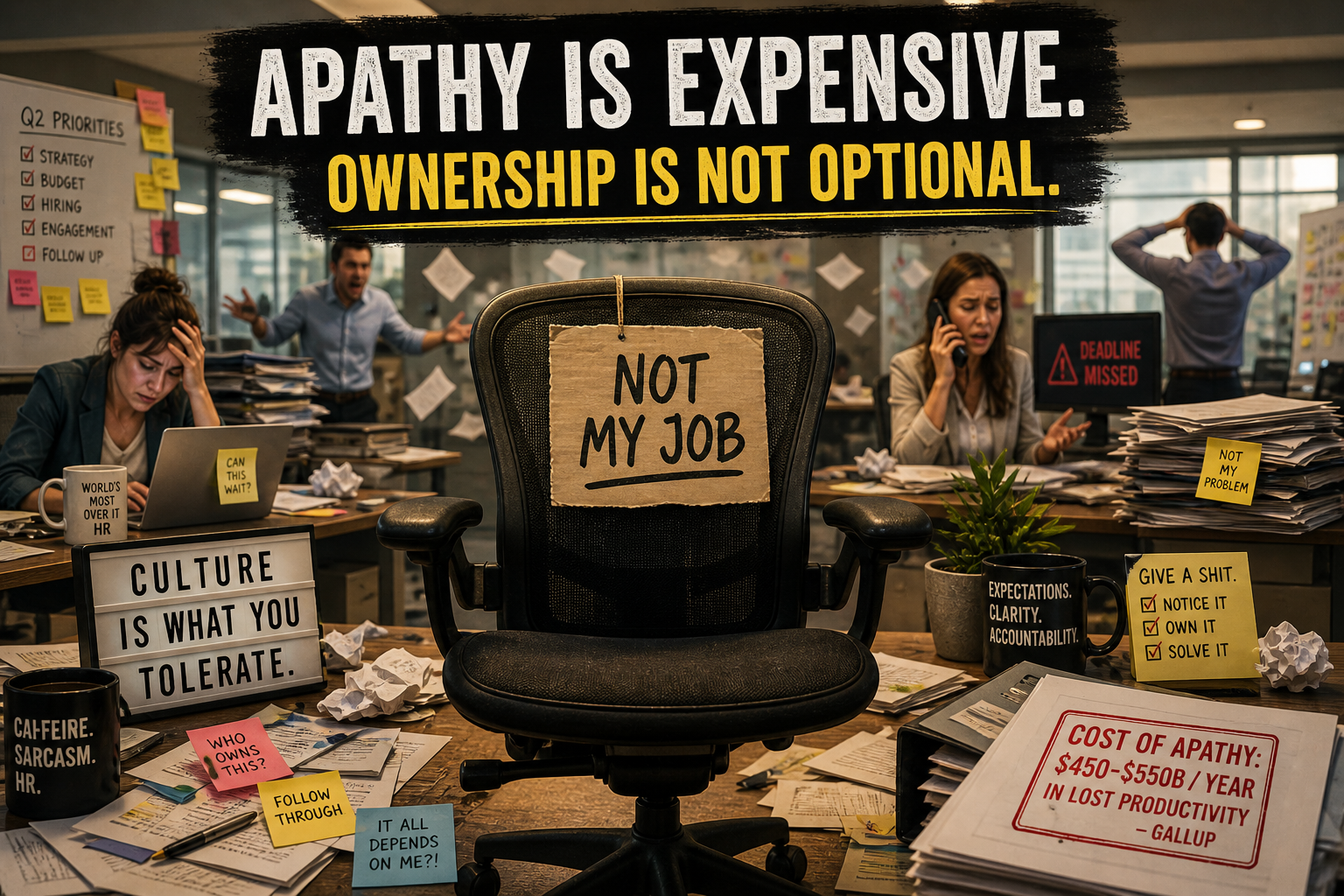
A cluttered office with an empty chair in the foreground that has a sign reading “Not My Job.” Around it are piles of paperwork, sticky notes, and reminders about missed deadlines. In the background, employees look overwhelmed and frustrated. The image includes bold text at the top that says “Apathy Is Expensive. Ownership Is Not Optional.”
An HR Millennial’s Reality Check on Engagement, Ownership, and Why Apathy Is Expensive
Let’s get uncomfortable for a second.
Every workplace problem eventually circles back to one thing no one wants to say out loud in a leadership meeting:
We need people to care. Like, actually care. A baseline, minimum viable level of “give a shit.”
Not “burn yourself out” care.
Not “live, laugh, spreadsheet” care.
Just enough care to do the job you were hired to do, notice when things are broken, and not treat work like an elaborate group project you plan to ghost.
And before anyone clutches their pearls and says, “HR can’t expect feelings,” relax. This is not about passion. This is about responsibility.
Because apathy is not neutral. It is expensive.
Engagement Is Not a Vibe.
It Is a Business Metric.
Let’s talk about data before feelings.
Gallup estimates that low engagement costs U.S. companies between $450 and $550 billion every year in lost productivity. Billion. With a B. That is not a “people problem.” That is a financial hemorrhage.
Globally, only 23% of employees are engaged at work. That means over three quarters of the workforce is either quietly disengaged or actively checked out, while still cashing payroll checks and attending meetings that could have been emails.
And here is the kicker.
Most disengaged employees are not malicious. They are unclear, disconnected, or unsupported. Which means leadership still owns part of the mess. If that hits close to home about someone you can name on your team, take a minute to live in that and just maybe own a piece.
But also… At some point… Adults have to adult.
“Give a Shit” Is Not an Attitude Problem. It Is a Standard.
HR sees this constantly.
Employees say things like:
“No one told me that mattered.”
“I didn’t think that was my responsibility.”
“I assumed someone else was handling it.”
And leaders say:
“They just don’t care.”
“No one takes ownership anymore.”
“Why do I have to explain everything?”
Here is the truth both sides need to hear.
Caring is not a personality trait. It is a clearly defined expectation.
You do not get engagement by demanding it harder. You get it by setting standards so obvious that opting out is a choice, not an accident.
A certain level of give a shit looks like:
Noticing problems and raising them.
Following through without being chased.
Understanding how your role impacts other people.
Doing the work even when no one is clapping.
That is not above and beyond. That is baseline.
Leadership Sets The Bar.
Employees Choose To Step Over It Or Not.
This is where Millennials in HR get spicy, because we see both sides.
If leaders do not:
Define what ownership actually looks like
Tie work to outcomes and impact
Reward accountability consistently
Address apathy early instead of letting it fester
Then you have not built a culture. You have built a suggestion box with paychecks.
But also. If expectations are clear, support is present, and feedback is given, and someone still refuses to engage?
That is not confusion. That is a choice.
And choices have consequences.
(Did anyone else just read that in their mom’s voice? No? Just me?)
According to Harvard Business Review, teams with high accountability outperform peers by up to 25 percent. Not because they work longer hours, but because fewer things fall through the cracks of “not my job.”
Accountability Without Care Is Control. Care Without Accountability Is Chaos.
Here is the balance everyone keeps missing. You cannot spreadsheet your way into engagement. You also cannot therapy-session your way out of accountability.
People want to know:
What is expected of me?
Why does it matter?
How will success be measured?
What happens if I consistently do not meet the bar?
When those answers are fuzzy, people disengage. When those answers are clear, most people rise.
And for the ones who do not? That is not a culture issue. That is a performance issue.
Why This Matters Right Now
We are in a labor market where retention is fragile, burnout is real, and patience is thin.
Deloitte reports that organizations with strong cultures of accountability and communication are 3.5 times more likely to outperform competitors and significantly more likely to retain talent.
People do not quit because work is hard. They quit because it feels pointless, chaotic, or unfair.
A culture that expects a basic level of give a shit, and models it from the top, creates stability.
Stability creates trust.
Trust creates performance.
Final HR Truth Bomb
Caring is not optional.
Clarity is not negotiable.
Accountability is not mean.
The workplace does not need more ping pong tables, vague values posters, or forced fun. It needs adults who know what they own and leaders who are brave enough to say when the bar is not being met.
So yes, we need a certain level of give a shit.
Defined clearly. Modeled consistently. Enforced fairly.
Because culture is not what you say in onboarding. Kudos for having it written down though. It is what you tolerate on a Tuesday afternoon when no one is watching.
A Millennial in HR, still trying, still caffeinated, still rooting for everyone to do better,
-Sarah B