
Drama Isn’t A Department. Why Do You Keep Clocking In?
I've spent more than 30 years in Human Resources.
I've interviewed thousands of people.
And there is one interview answer that immediately makes my HR ears perk up.
"My last workplace was so toxic."
Or...
"There was just so much drama."
Now, before everyone rushes to the comments...
Yes. Toxic workplaces absolutely exist. I've helped employees leave organizations with poor leadership, bullying, harassment, discrimination, and cultures that genuinely needed a complete overhaul.
This isn't about those workplaces.
This is about the people who seem to have worked at five toxic workplaces in a row.
At some point...It's worth asking a really uncomfortable question.
If everywhere you go smells like smoke...is it possible you're carrying the matches?
I know. Ouch.
But stay with me.
One of the things I've learned over three decades in HR is that people often tell you exactly who they are, if you're willing to listen.
When a candidate spends ten minutes explaining how awful every former boss was, how every coworker was immature, and how every office was "full of drama," I'm no longer evaluating their previous employer.
I'm evaluating how they talk about people when they leave.
Because here's what usually happens.
A few months later...
They're sitting in my office telling me:
What Susan said about accounting.
Why marketing is upset with sales.
Who rolled their eyes in the meeting.
Who's mad at whom.
Who unfollowed whom on social media.
And, of course, "Don't tell anyone I told you..."
The person who claims they hate drama somehow has season tickets to every performance.
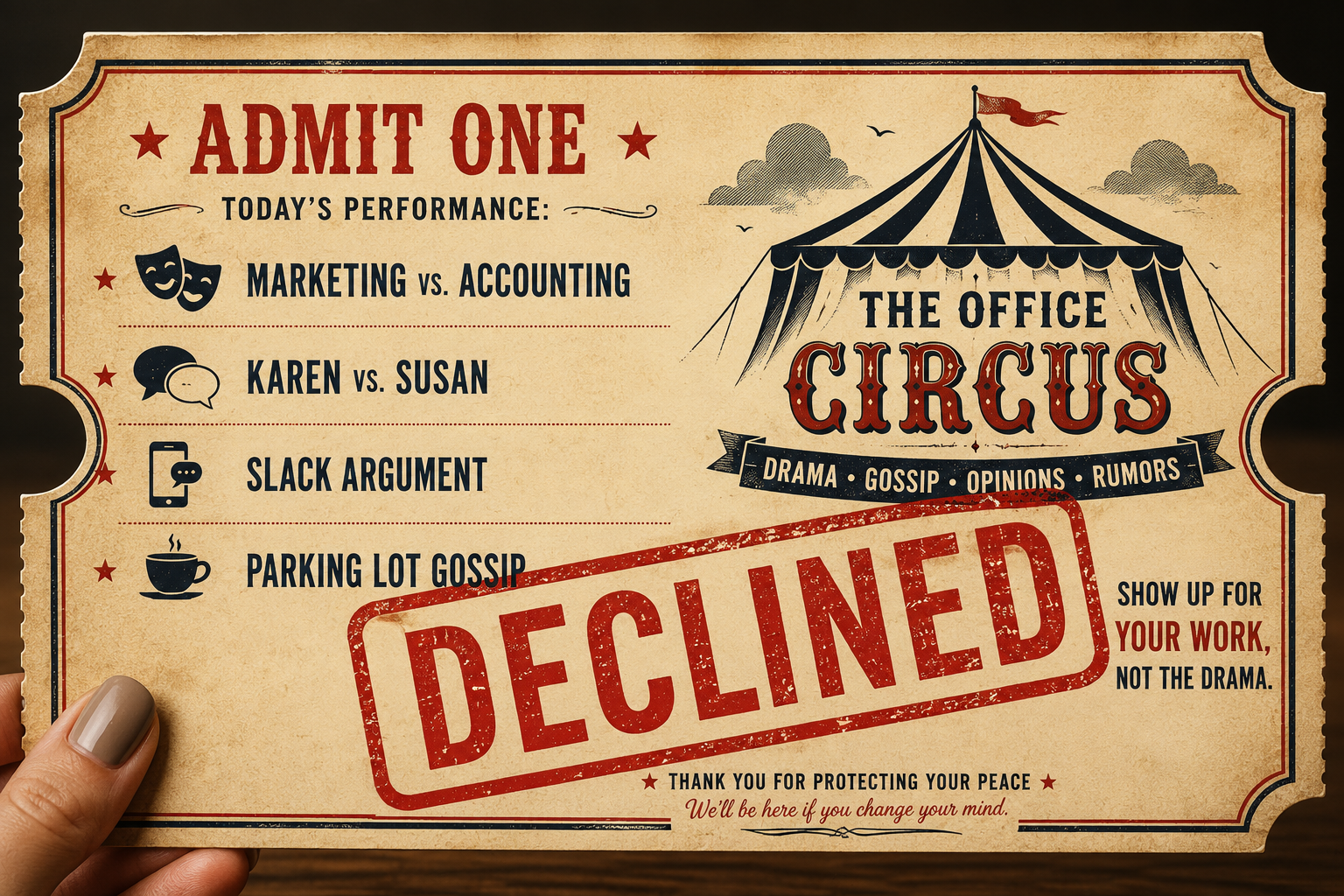
Here's the thing about the office circus. It only stays in business if people keep buying tickets.
Drama needs performers.
It needs ringmasters.
It needs spectators.
It needs people willing to clap, gasp, gossip, speculate, and recruit others into the next act.
If everyone simply walked out of the tent...The show would end.
Research tells us this isn't just annoying, it's expensive.
SHRM reports that employees lose an average of 34 minutes of productivity every time they experience or witness an uncivil interaction, and workplace incivility costs U.S. employers billions of dollars every day in lost productivity and absenteeism.
Even more telling, 26% of employees say they've considered leaving a job because of workplace incivility.
Think about that.
Companies spend thousands recruiting, hiring, onboarding, and training employees...
Only to lose them because grown adults can't stop acting like they're starring in a reality TV show.
Here's another little HR secret. I've never once heard a leader say,
"Let's promote Jennifer. She always knows everybody's business."
Or,
"We should make Mark a manager. He's the first person to tell us who's mad at whom."
No.
People get promoted because they're trusted.
Because they're discreet.
Because they solve problems instead of narrating them.
Professional employees don't necessarily know less than everyone else. They simply choose to know less about things that aren't their business.
That's not ignorance.
That's wisdom.
One of my favorite questions is:
Does this involve me, require me, or improve because of me?
If the answer is no...Keep walking.
Not every disagreement deserves your opinion.
Not every rumor deserves your attention.
Not every conflict deserves your participation.
And certainly not every argument deserves your attendance.
Minding your own business isn't passive. It's professional. We don't have to show up for every argument we're invited to, every rumor we're told, or every conflict someone wants us to join. Sometimes protecting your peace is also protecting your reputation.
Now let's flip the mirror around for a minute.
It's easy to say:
"My boss never communicates."
But did you?
It's easy to say:
"Nobody appreciates me."
When was the last time you appreciated someone else?
It's easy to say:
"Everyone here is negative."
What attitude did you clock in with this morning?
Culture isn't created only in the boardroom.
It's created in the break room.
In Teams messages.
On Slack.
In the hallway.
In every conversation we choose to have...or choose not to have.
Every employee contributes to culture, whether they realize it or not.
Gallup has consistently found that highly engaged teams are more productive, more profitable, have lower absenteeism, and experience significantly lower turnover than disengaged teams.
That doesn't happen because leadership ordered pizza on Friday.
It happens because people choose accountability.
And because they choose grace.
Here's where I think we've lost the plot.
Some people weaponize accountability.
Others weaponize grace.
Neither one builds a healthy workplace.
One of my favorite reminders, courtesy of my colleague Sarah, is this:
Accountability without grace becomes judgment. Grace without accountability becomes excuses.
We need both.
Hold people accountable.
But remember they're human.
Offer grace.
But don't excuse behavior that hurts the team.
The healthiest workplaces I've ever seen aren't the ones without conflict.
They're the ones where people choose curiosity over assumptions.
Solutions over gossip.
Ownership over blame.
Grace over outrage.
And maybe, just maybe...
They stop buying tickets to the circus.
Because the office circus only stays in business if the audience keeps showing up.
What would happen if we all simply walked out of the tent?